What Types of Office Potlights Do We Install?
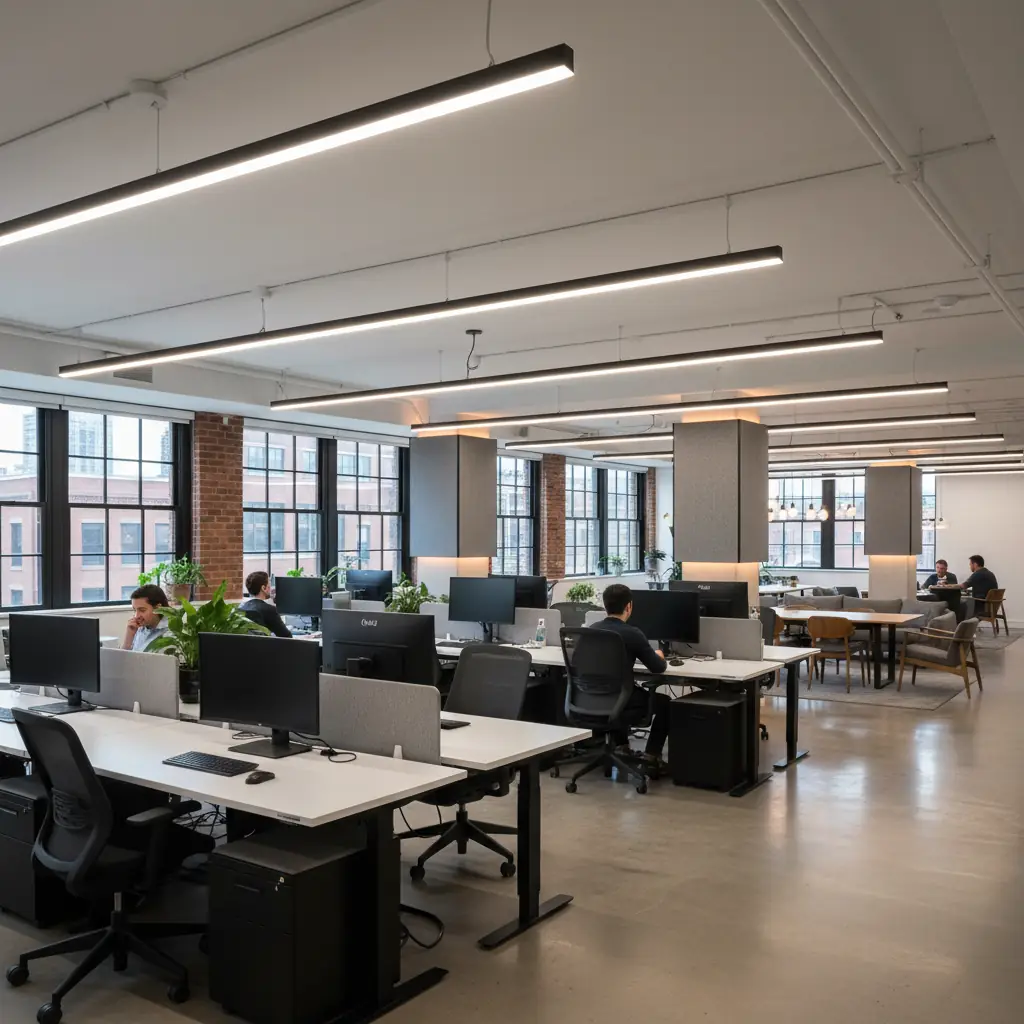
Open-plan workstations, private offices, meeting rooms and photography studios each need a different fixture and sensor setup. Picking the wrong one is how you end up with eye fatigue on video calls, wasted hydro on empty rooms or washed-out skin tones in your studio footage. Here’s what we install most for potlight installation in Toronto office and studio buildouts.
4000K slim 4-inch LED potlights for open-plan workstations
The go-to for open-plan office ceilings. Thin canless wafers at 4000K with 90+ CRI keep workstation alertness up without clinical glare over an 8-hour day. We buy them through Nedco Toronto in dimmable 4000K with low-flicker drivers rated for extended video call exposure. Dimmable down to 10 percent on Lutron Vive wireless dimmers.
3500K warm bias for private offices
Private offices and executive suites get slightly warmer 3500K at the same CRI 90+. The warmer bias extends meeting comfort over 1 to 2 hour conversations and reads better on camera for exec video calls. Tunable fixtures let the occupant shift to 4000K for focused solo work.
Occupancy and daylight sensors paired with each zone
Perimeter workstations near south-facing windows get ceiling-mounted daylight photosensors that auto-dim the nearest fixtures when natural light exceeds the threshold. Meeting rooms, washrooms and private offices get occupancy sensors that shut lights after 2 to 5 minutes of no motion. Combined savings typically run 30 to 50 percent on lighting hydro.
6500K daylight-matched LEDs for photography studios
Photography and video studios need daylight-matched 6500K at CRI 95+ so skin tones and product colours render accurately on camera. We spec Juno and Satco Starfish fixtures with the daylight-match driver and mount them on dedicated circuits separate from the office floor so the studio zone can be dimmed or shut independently of main office hours.
How Much Does Office Potlight Installation Cost in Toronto?
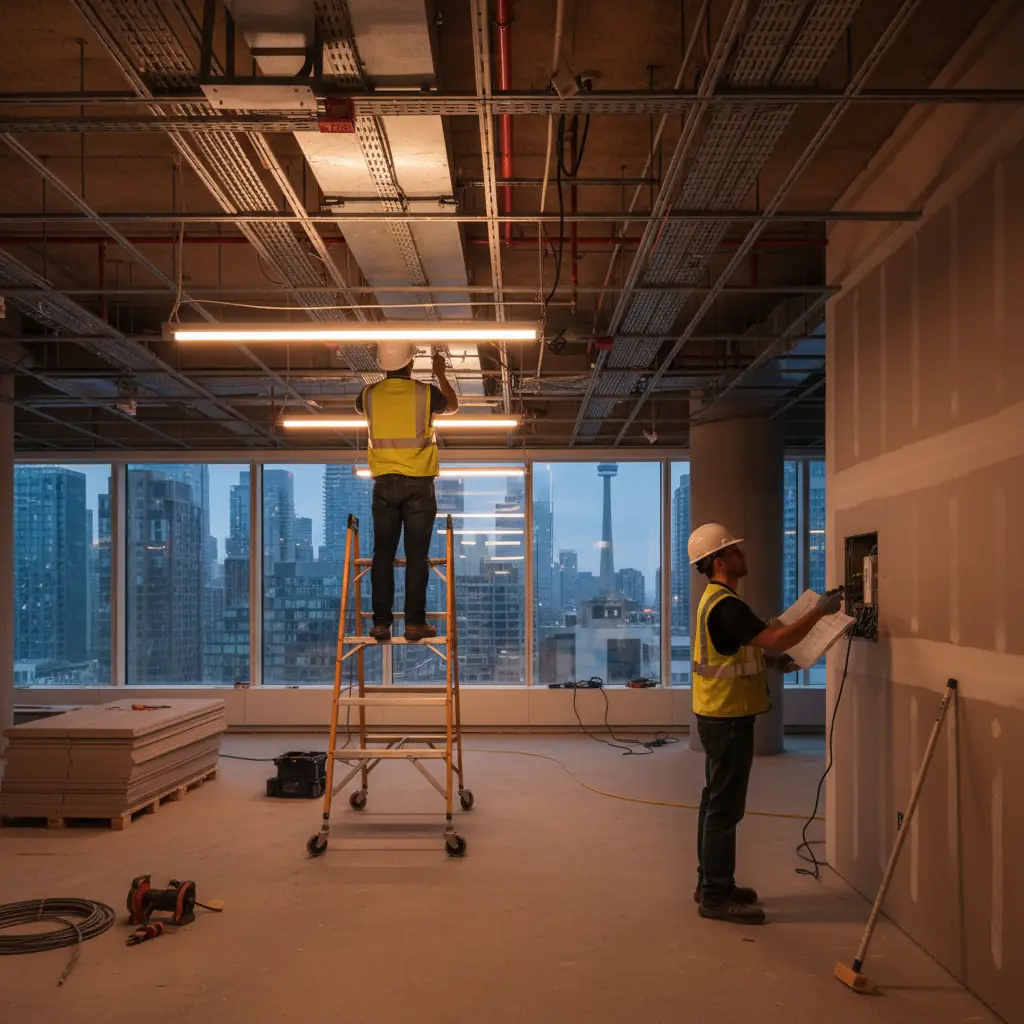
Our office pricing is all-in: 4000K fixtures, after-hours labour, Lutron Vive wireless zoning, daylight and occupancy sensors where specified, ESA notification and the drywall patch on removed fluorescents. Here’s what moves the number up or down.
| Cost factor | Lower end | Higher end |
|---|---|---|
| Office square footage | Up to 2,000 sqft, from $3,600 | 4,500 to 6,500 sqft, up to $18,500 |
| Ceiling type | Suspended T-bar troffer swap | Finished drywall or exposed ceiling |
| Zoning | Single Lutron Vive office zone | 10+ zones with per-room photosensor and occupancy |
| Sensor stack | Basic daylight sensors only | Full daylight plus occupancy on every meeting room |
| Studio addition | None | Photography or video studio adds $1,800 to $4,200 |
Older Liberty Village and King-Spadina loft offices with exposed concrete or brick ceilings need surface-mount cylinder fixtures that cost 25 to 35 percent more than drywall recessed. We’ll quote all of that on the written proposal so you don’t see surprises on install night one.
When Is It Time to Retrofit Your Office Lighting?
Most office owners and facilities managers call us for one of four reasons. First, old fluorescent troffers are flickering visibly on video calls and triggering headache complaints from staff. Second, lighting hydro is dominating the operating cost line and ownership wants a visible sustainability win. Third, a tenant improvement buildout or office refresh means the ceiling is already being touched and lighting is cheapest to upgrade at the same time. Fourth, a hybrid return-to-office plan is bringing more occupancy sensors and bookable meeting rooms into scope.
Monday through Thursday evenings are our busiest install windows for offices. If you have a specific move-in date or buildout deadline, book the walkthrough four to six weeks ahead.
Common Office Lighting Problems We Fix
Fluorescent flicker on video calls
Old T8 and T12 fluorescent troffers flicker at 60Hz which shows up as rolling bars on webcam footage. LED potlights with high-frequency drivers eliminate the flicker completely, so video calls look clean on client-facing recordings.
Hydro bills dominated by lighting line
Older office lighting runs 24 hours in a lot of leases. Occupancy sensors and daylight photosensors drop lighting draw by 30 to 50 percent across a typical open-plan floor.
Headaches and eye fatigue after 4 PM
Flicker above 20 percent at low dim settings is invisible but gives staff physical symptoms by late afternoon. Low-flicker drivers under 5 percent across full dimming range solve this immediately.
Mixed colour temperature from retrofits over the years
Lighting replaced piecemeal over 10 years ends up with 2700K, 3500K, 4000K and 5000K all in the same floor. Tunable Lutron Vive fixtures let you unify the colour temperature across the whole floor and set a smooth gradient between workstation and private office zones.
Office Potlights vs Troffer Panels or Smart-Bulb Retrofits
Keeping old fluorescent troffers and swapping to LED tubes saves 15 percent upfront but you lose the dimming, sensor integration and the flicker reduction that matters. Smart-bulb retrofits over existing wiring work for small 1 to 5 fixture residential conversions but they don’t integrate with Lutron Vive wireless zoning or daylight photosensors at commercial scale. Dedicated LED potlights with full sensor stack and wireless zoning are the professional spec, and they pay back on hydro savings within 18 to 30 months for most Toronto offices.
Want to see where your fixtures and sensors would land across the floor? Book a free after-hours walkthrough and we’ll draw the zoning plan before your next week-night close.